Kouri Richins: Dark Cinderella, Pt. 1

The original Cinderella was a murderer.
Written in 1634, in the Italian version, Cinderella kills her cruel stepmother with the lid of a heavy trunk to escape her suffering.
The second story of Cinderella, written by Charles Perrault about forty years later, is more recognizable with the glass slipper and fairy godmother—but she, too, has a morally perilous position: her perceived identity is a beautiful, captivating mask of luxury and class that is summoned by magic but promised to fade. Like all masks, really.
The third story of Cinderella, this one by the Brothers Grimm in 1812, is the darkest yet. In this version, Cinderella also deceives the prince with magic—she’s whipped into a gold and silver dress summoned by fairy magic, thus capturing his attention and then his heart. But when her two stepsisters attempt to also deceive the prince by cutting off their respective toe and heels to fit into a golden slipper, they are later punished for their deception by having their eyes plucked out by pigeons at the wedding.
Perhaps the moral of that particular story is not that you shouldn’t lie, but that only god-tier fabrications can pull down a prince.
In the latter two stories, Cinderella’s “wicked” stepsisters play a prominent role. They’re jealous of Cinderella’s beauty, grace, and natural class, and this jealousy is why they’re so terribly cruel to her. The stepsisters are haters with the sour faces of two women drinking a fresh cup of haterade.
For those of you who are new to this story, let me put you on game. In March of 2022, Kouri Richins, a failing realtor with millions in debt and mother of three, murdered her husband, Eric Richins, a successful contractor and father to their three boys, by slipping enough illicit Fentanyl into his Moscow mule to kill him five times over. The motive? To use his house, his business, and his life insurance policies to buy her a fresh start at a more affluent life. Then, in 2023, she published a children’s book about grieving a dead parent and featured cartoon likenesses of Eric as an angel looking over their sons.
No, wait, it gets worse. There’s the fact that Eric warned family and friends that "if anything happens to me, Kouri did it.” Prior to being murdered, Eric secretly put his business share, his home, and some of his life insurance policies in a trust and appointed one of his two sisters as executor of that trust. Kouri had no idea that, when she finally killed him, he had already moved those funds out of her reach to protect his boys’ financial future from a person who couldn’t keep a dollar if it were glued to her face.
Wait, wait, wait. I’m not done. Have I mentioned that Kouri took out a line of predatory payday loans that runs so deep, your palms will start sweating from the contact stress? I’m surprised Kouri still has her knees. There’s a secret paramour, a man without pants, a gay sexting scandal, one of the worst betrayals of a best friend I’ve ever seen; enough lying to make you wonder if Kouri has a very special kind of disorder, and enough self-snitching to make you think this has to be made up because who is that stupid?

Don’t worry, as we get into things, I will give you more background because we’re going to start from the beginning and then go straight through to the end. A dear friend pointed out that a flowchart would be helpful, so I’ve made one. I’ll include it in each of the segments for your convenience (Thanks, PJ!). Everybody say: “Thanks, PJ!”
So now you know how everyone is connected in the families, what then is connecting Kouri to these Cinderella stories? Let’s look.
In each of the 17th-century stories, Cinderella is a tragic kid abandoned by her mother through death and then her father through remarriage. Or is it that she’s abandoned by her father due to his incarceration and alcohol addiction, and then her mother is lured from home by the perpetual lights and ringing chimes of the casino? (#foreshadowing)
In each of the 17th-century stories, Cinderella finds herself in a dire situation. In each of these stories, Cinderella’s marriage serves as a means of escaping oppressive circumstances at home.
And, if you are still wondering why this series of essays about Kouri Darden Richins has begun with three of the darkest Cinderella stories known, then, my dove, my sweet little pigeon, the telling of this tale begins with Cinderella because Kouri Richins believed—and possibly still believes—that she is Cinderella.
Evidence from the trial demonstrates that Kouri subconsciously believes she is Cinderella. Let’s start with Docket 214, the one that every law nerd on the internet calls the Walk the Dog letter.
If you’re not familiar with the Walk the Dog letter, it’s a letter Kouri wrote to her mother after her arrest. Kouri had been imprisoned for four months and was then working with famed defense attorney Skye Lazaro. In a video call with her mother, Lisa Darden, Kouri holds up a handwritten letter to the camera for her mother to screenshot its contents.
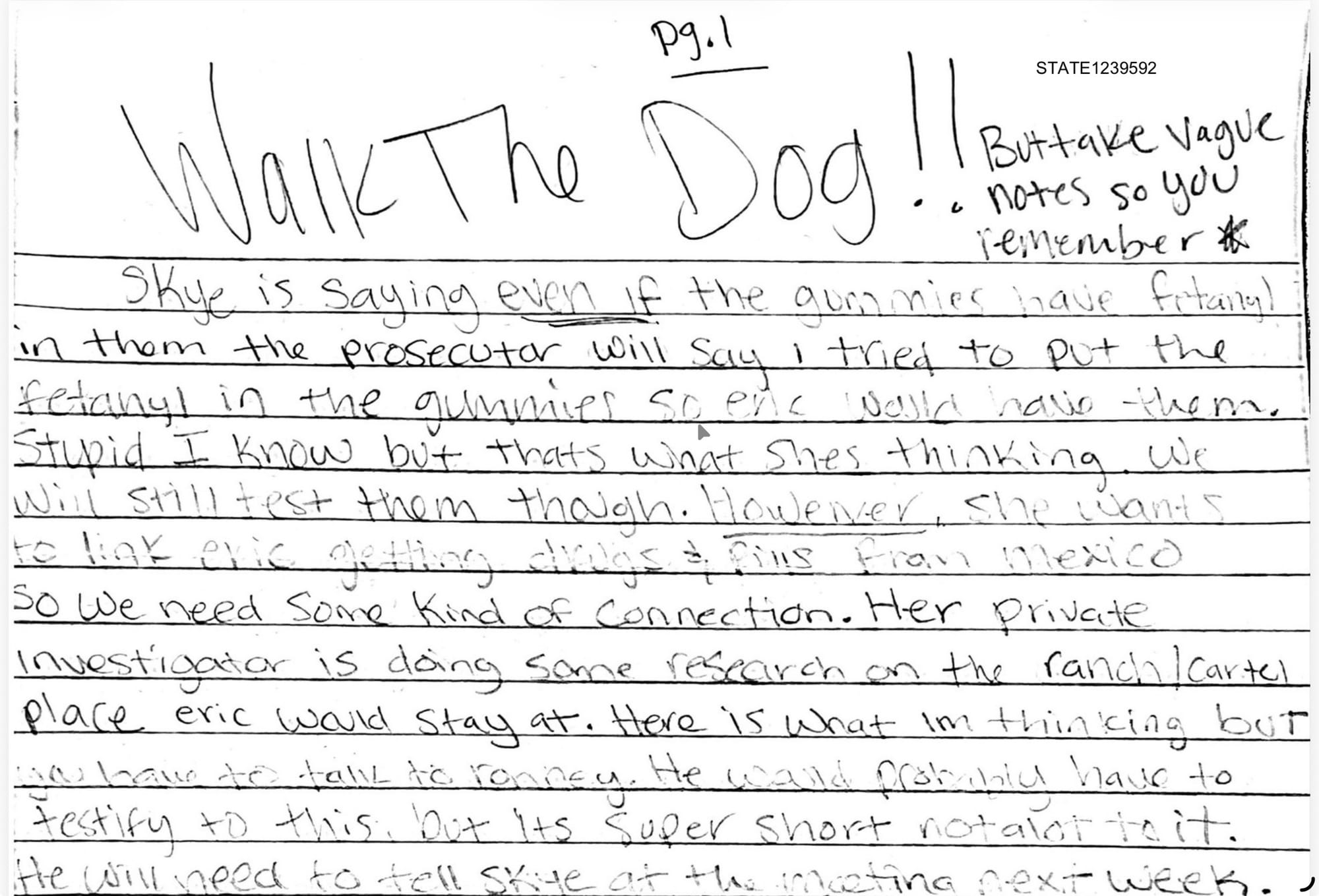
Corrections officers later intercepted this letter and found within it one of the most astonishing features of this trial: within the Walk the Dog letter, Kouri instructs her mother to feed exculpatory testimony to Kouri’s brother Ronnie, who had yet to speak with Kouri’s defense attorneys. If you haven’t had your coffee yet today, this behavior is called witness tampering.
The story Kouri proposes is one in which her murdered husband, Eric, had a secret addiction to fentanyl that absolutely no one knew about—not even Kouri—which is why she was still presumably in lockup: she didn’t know about her husband’s fake secret addiction. I’ll go into this letter more at another time, but it also instructs Kouri’s mother, Lisa, to send pictures of her sister-in-law’s children to the media. Yes, with a national spotlight on this case, Kouri intended to put pictures of her sister-in-law’s minor children in the news. This would then cause those children to be recognized publicly, likely draw attention from classmates, but also raise a parent’s hackles on having their innocent child exposed to the world as retribution for being Eric Richins’ sister. If you haven’t had your coffee yet this week, this little behavior is called witness intimidation.
Kouri instructs her mother to take care and “walk the dog” while relaying Ronnie’s planted testimony, which is to say, talk about this outside. Kouri suspects that prosecutors and the FBI have bugged her mother’s house. (It wasn't.) If Kouri's mother and brother were caught manufacturing testimony Ronnie should already know; it would blow the whole thing to banana-rama-ding-dong. (#foreshadowing)
If you haven’t had your coffee yet this year, this is all very, very stupid. But! Back to Cinderella.
At the top of page six of the Walk the Dog letter, Kouri instructs her mother on the real reason Kouri has cruelly ended up in jail: it’s because of Eric’s two evil sisters working against her.
“…talk about how the sisters have always been jealous of me because anything they could do, Kouri could do better. Being a mom, college student, and stay-at-home wife until she built a million-dollar company. A nice house, car, and everything she had, they wanted.”
(Psss. To quote the first among law nerds, Emily D. Baker: “It’s not a million-dollar business if it’s a million dollars in the negative, Kouri.”)
Kouri even promises retribution against the evil sisters who have made her suffer in prison. (At the time of this writing, just prior to Kouri’s sentencing, this fact comes back to bite her in the ass again, but we’ll come back around to that later.)
Earlier in the same letter, Kouri writes, "Bring me home, and then we will get those damn bitches.” Kouri’s too ambitious to wait for a couple of magical pigeons to enact revenge; she’s got things to do.
Cynicism aside, there’s a softer, darker, deeper, and more complex set of questions to examine here within that Cinderella analogy.
There are aspects that make this particular trial sad in unusual ways: many of us feel some sympathy for Kouri because she is, in fact, a tragic figure on a Shakespearean scale. Abandonment and neglect in childhood are terrible and painful things, the consequences of which I don’t think our society has sufficiently comprehended, and these are important players in the circumstances leading up to Kouri murdering a wonderful, loving father, brother, and son named Eric Richins.
Even the jurors who convicted Kouri of aggravated murder and attempted murder (because she was unsuccessful the first time) sensed that sympathetic undertow running beneath the cold, hard facts of the case. The foreperson said in an interview with Good Morning America, “There was never a not guilty check with anything… Each juror had their own smoking gun. People were really sad because they did not want to find her guilty; they were really hoping that she was innocent.”
There are aspects of Kouri’s life that I relate to, things so similar to my story that I feel something like Truman Capote felt writing about the convicted murderer Perry Smith when he said, “It’s like we grew up in the same house, and one day I went out the front door, and Perry went out the back.”
Like others with CPTSD, I feel I intimately understand the emotional, logical, and moral failings Kouri lives within better than I’d like, and I’m going to take that knowledge and explain here why Kouri’s Cinderella story ended in horror and tragedy rather than happily ever after; the subconscious drives and assumptions that piloted her path; and the points in the path that, when they escalated, drove Kouri to carve her own happily ever after out of Eric’s life.
I’m not suggesting that Kouri isn’t guilty or that she isn’t wholly to blame for the horrifying actions she took; SHE IS, and she should serve the longest possible sentence for what she’s done, and that is still not enough. This series is meant for us as a community to look at what may have happened and to search for ways to prevent it from happening again in whatever ways we can. Perhaps by first looking at ourselves with a little more love and understanding.
The sympathy so many feel toward Kouri is present because we subconsciously recognize the fairy tale patterns within this case. We’ve heard the stories a thousand times, and the inner currents of our imaginations want to correct the details of Eric and Kouri’s outcome. We instinctively want the story to match the rags-to-riches, good-will-overcome-mean-girls version of Cinderella that we’ve grown up on: the Disney tale that says that, if you are very nice to animals and have a dream, a dream that you wish will come true. Magically.
Which is also how Kouri expected to resolve the millions of dollars in debt she had racked up. And also how she expected to escape her charges and walk out into the free air of northeast Utah: magic.
When I say "Magic," you say “Lies.”
Magic.
NEXT UP: Dark Cinderella - Rags to Richins
Thank you for reading.
If you’re enjoying this series, please consider sharing and supporting my work by buying me a cup of coffee! I appreciate it, and it goes a long way to helping me do more of what I love most.
Referenced notes and sources:
- Find an English version of “The Cat Cinderella” by Giambattista Basile written in 1634 here. Note that in this, Cinderella is called Zezolla. Fun fact: many think that the detail of Cinderella killing her stepmother with the lid of a heavy trunk is taken from the real life, social-climbing, murderous queen named Fredegund. Fredegund attempted to kill her own daughter in this way. The whole medieval period needs therapy.
- Here’s a handy link to Perrault’s version of Cinderella with the first mention of the glass slipper.
- “Every law nerd on the internet” is a quote from a pretrial hearing by Prosecutor Brad Bloodworth. I developed a massive crush on him by the halfway point of this trial. What an incredible brain.
- Read through the entire Walk the Dog letter here.
- See the jury foreperson interview here.
- If you’d like to use the chart I made, please do me a solid and back link my article! I’d appreciate it!
- Bryce’s pants have been missing since 2022, but we haven’t given up hope in finding them. You will get the entire scoop on this reference soon. We’ll come back around to it.
Humor aside, please join me in respecting the privacy and feelings of the Richins family and in honoring Eric’s memory. The Darden family is also hurting. Kouri has done incredible destruction to several families. This writing is not meant to glorify the killer and erase the victim. At the center of this is a father who gave everything to protect his children.