Kouri Richins: Rags to Richins (Dark Cinderella Pt. 2)

Cinderella’s story always ends with her marriage to the prince. But this chapter is where Kouri’s dark turn begins.
In this installment I’m going to cover the deep past. We’re going to look at the childhood circumstances that led to Kouri’s feelings of grievance and alienation. And we’re going to look at a situation that arose on Kouri's and Eric’s wedding day that will leave you haunted with its connection to the murder.
But before that, let's take a brief look at the family background of our handsome cowboy prince, Eric. The contrast between the Dardens' family and the Richins’ family is striking; it’s also part of the friction that propels the disaster Kouri would later create.
Here’s that handy graphic of who is who in our story.
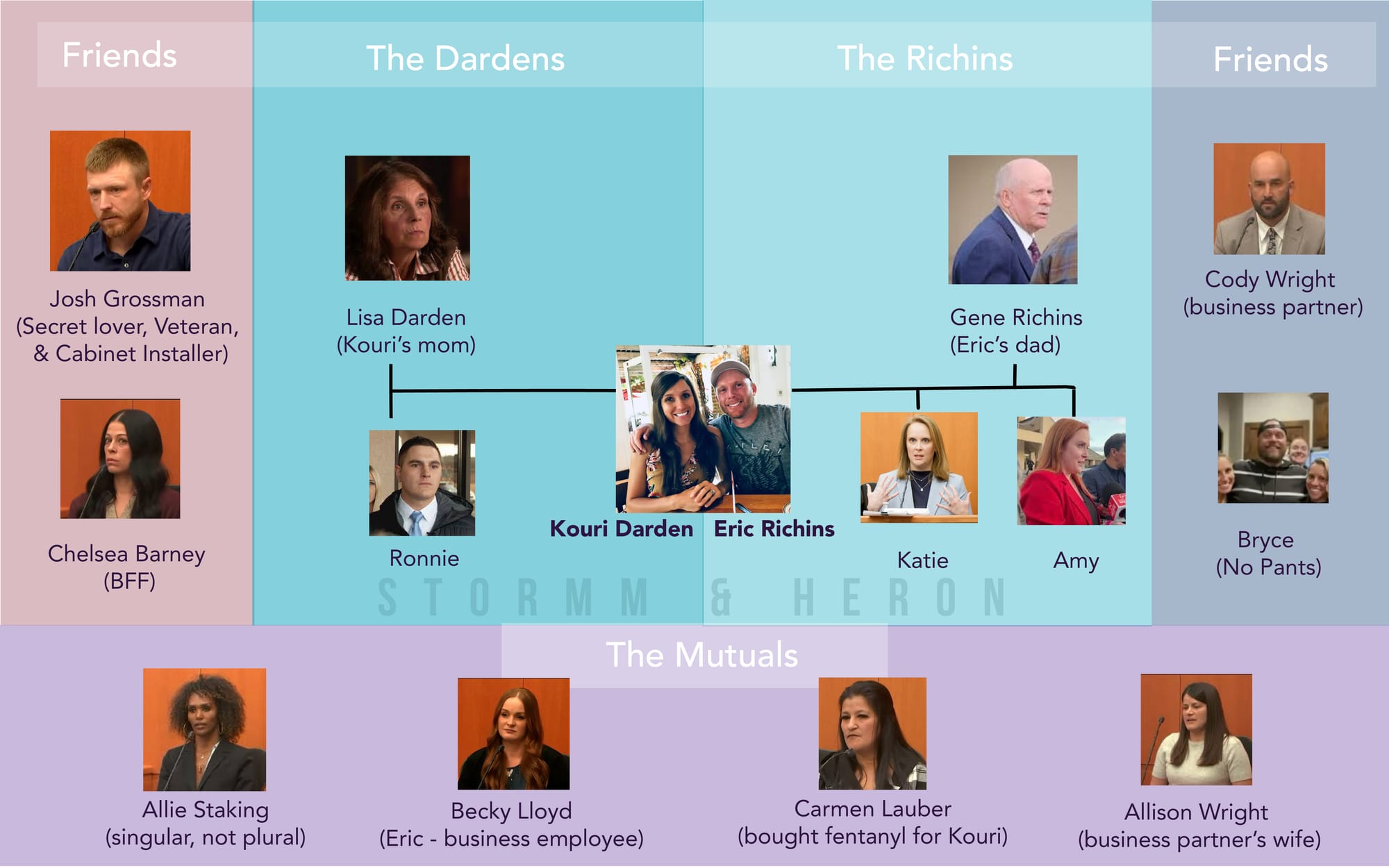
Information about the Richins family is limited, and I think that’s a good thing: suffering such incredible trauma doesn’t mean that their privacy should also be forever broken. Out of respect for their privacy, I’ve skipped researching anything that didn’t come out in trial. Here’s what I know: they’re a close-knit, ranching family with strong Mormon faith and a work ethic that is generations deep. Eric’s father, Gene, is a rancher. Eric’s mother passed several years ago from a rare lung condition that would cruelly come back up after Eric’s murder.
Ranching requires land and structures on the land to house cattle and other livestock needed for—well, ranching? Land, structures, and livestock (cows, sheep, horses) ain’t cheap, so chances are, if you come from an established ranching family, you have a stabler relationship with money than—well, Kouri’s family.
We learned at trial that Kouri was born in Oklahoma to a blended family. Both of her parents worked in engineering, which means that on paper she might have had a similar socioeconomic life to Eric if it weren’t for all the exceptions. And these exceptions make me sad. I don’t come from a family in which addiction factored into our instability, but I feel sad because ostensibly the Darden family could have made it.
The Darden family parents (Kouri’s mother, Lisa, and her father) had a matched set of addictions. Kouri’s father was an alcoholic, a condition that would lead to him striking a police officer while driving under the influence and being sentenced to a few years in prison. No doubt having an imprisoned parent hurt the family economically as well as impacting their social status and their emotional life.
Kouri's father's absence paved the road for the parentification of Kouri’s older half-sister, who became a compulsory caretaker, to say nothing of the abandonment trauma impacting that same sister, Kouri, her brother Ronney, and her mother, Lisa.
Lisa Darden had an addiction of her own: gambling. When it came to love, affection, instruction, and emotional availability, Kouri was “zero for two” with her parents.
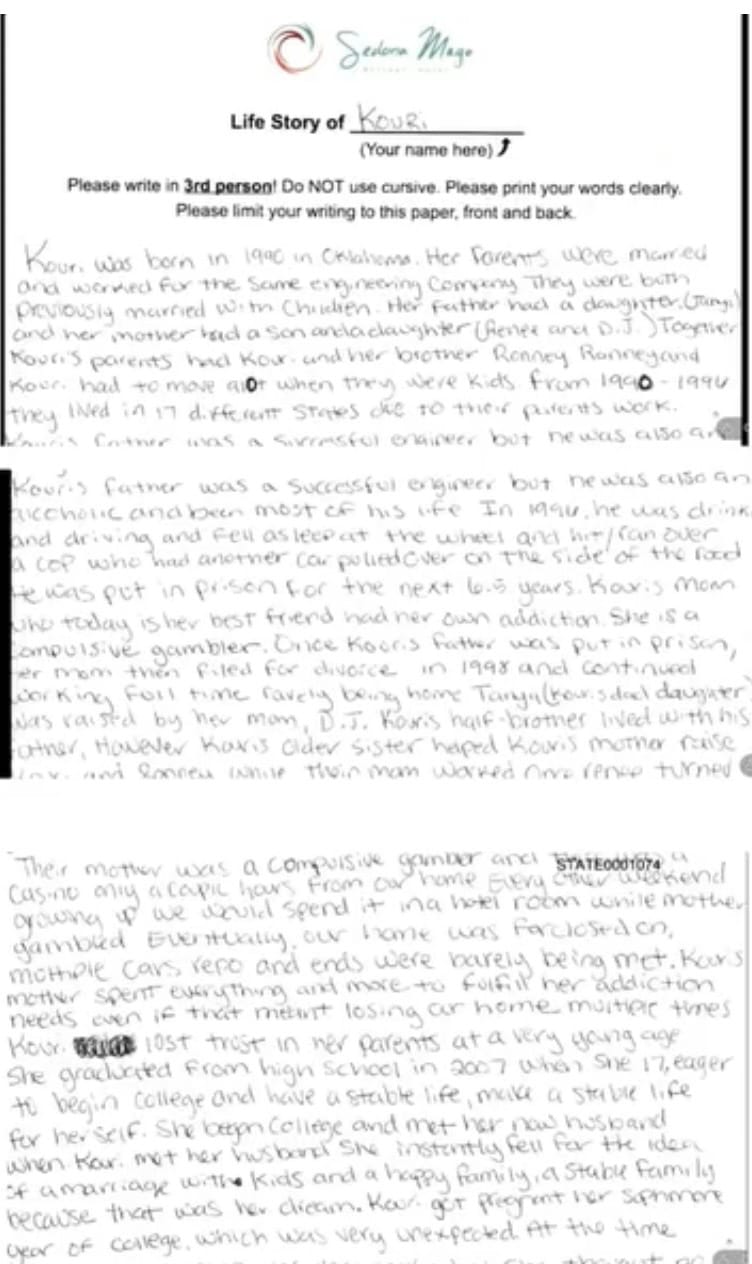
More heartbreaking information came out about Kouri's childhood in the trial. Evidence of a “life story” Kouri had penned while at a retreat in Sedona revealed that Lisa began working round the clock to support the family, but she also maintained a steady gambling habit that left Kouri and her younger brother alone in hotel rooms while the bank repossessed a stream of cars and houses. In her own words, Kouri wrote, “Kouri lost trust for her parents at a very young age.” Crushing!
Those words scrawled onto a paper with the retreat letterhead are going to become a critical part of the motive, mechanism, and MAGIC Kouri would later employ to have everything Eric’s sisters supposedly wanted, so remember them.
This generational loss of status and wealth is another thing Kouri shares in common with Cinderella. In all of the Cinderella tales mentioned here, each of them describes a single parent of noble class who had lost their partner, remarried, and then either died or allowed Cinderella’s stepmother to have outsized control of Cinderella’s life while Cinderella's father drifted into anonymity.
Cinderella possesses status when she’s small; she comes from good breeding, and in one way or another, she is “zero for two” on both her parents.
Cinderella becomes a member of one of the lowest classes in the very house she had always called home. She is left scrubbing floors and looking after her snobby stepsisters, who look down on her due to her lowly status.
Kouri knows this pain intimately.
In a text message to her lover, Josh Grossman—the veteran and cabinet installer—on November 28, 2021, Kouri discloses that acquiring a property in Park City, UT, was a big deal for her because she grew up working for her aunt’s cleaning service. Kouri felt that the people in Park City looked down on her because she was “literally the person cleaning toilets.” Kouri vowed that she would one day have a property of her own in Park City, and she would show up those snobs.
Let's take a moment to appreciate the measured way Prosecutor Brad Bloodworth humanized Kouri’s internalization of the trauma without victimizing her. Bloodworth said, “She was not beneath those homeowners [of Park City], but she felt that she was.”
But that text in late 2021, written to her secret lover just four months before murdering Eric, was actually Kouri’s plan B: to purchase property in Park City to own independently as a real estate agent.
Plan A had been to marry Eric.
This is where stuff starts getting twisty.
I believe the dark turn Kouri’s story took, the turn that would later have her stealing from her husband and then murdering Eric with illicit fentanyl, began on her wedding day.
I risk getting ahead of ourselves here. Let’s lay more foundation before we get to the ominous ring of wedding bells.
In 2009, Kouri was in her early years of college, working at Home Depot, when she met Eric. Eric was eight years her senior and had built a thriving masonry business with his partner Cody Wright. According to mutual friend and Kouri’s co-worker Linda King, she and Kouri worked at the contractor checkout line, where Eric was a regular. It was she who had introduced the two of them. Thereafter, they were inseparable.

Linda describes the whole affair as “a fairytale romance.” Kouri was “as sweet as can be. Beautiful—everyone thought she was beautiful—and she was smart.” Linda guided her with some advice: “Don’t be a cashier. You gotta do things.” This advice was the equivalent of “There’s a big world out there, and you should make your way in it.” Much like Cinderella marrying a handsome prince, Linda felt that Kouri was fulfilling that reach for the bigger world by marrying Eric.
Kouri thought so, too. But she had a secret: she wasn’t in love with Eric; she was in love with the idea of a happy family, a stable family, a marriage with kids. That was Kouri’s idea of happily ever after: stability. But in adulthood, stability is something you create rather than something handed to you.
Even so, I deeply resonate with that dream. I think many survivors of child abuse and parental neglect can relate to that. You want the one thing that it looks like other people have, but you’ve never been able to have. When you discover an opportunity to have that stability, you think, "This is what will make me happy." For many of us, happiness comes from something external, something free from our past pain. We can even see that whatever version of a fairytale dream we have comes with challenges of its own. But those challenges seem minor compared to the hand that life has dealt you.
This desire for a happiness created outside of her is of vital importance to understanding Kouri’s view of the world. If you have CPTSD, it may also be deeply understandable. Once you have a glimpse of this worldview, you can begin to understand that her path to murdering the man who fought for her and gave her everything was a straight line and not a winding road.
Kouri and Eric got pregnant unexpectedly with their first son while they were still dating and she was a sophomore in college. Kouri confesses that at that point their relationship was already rocky. In 2012, Kouri gave birth and finished her bachelor's. The following year, in 2013, four years into her and Eric's relationship, they married.
And—if my information is correct—on the day of their wedding in the backyard of the house that was the lynchpin of Kouri’s Plan B, the final player in our dark fairy tale entered the chessboard and set the clock running: coercion, in the form of a prenuptial agreement presented at a highly leveraged time.
This also means that it was Kouri who was leveraging the Richins (and Eric.) By allowing the prenup to go unsigned, Kouri was forcing the Richins into a position that would make them look bad. After all, who pops a prenup on someone on their wedding day and holds off the ceremony until it’s signed? Kouri wants you to think that the Richins would.
The Richins family wanted to protect Eric from the disastrous results of his previous marriage. This desire i
s understandable considering they were privy to the rockiness that Kouri herself described. So the Richins family introduced a prenup that protected Eric’s assets against divorce and assured Kouri’s spousal rights to assets only in the instance of Eric’s death.
They presented the prenup just before the wedding, after the florals had been set, the chairs for guests arranged, the catering likely arriving or already on premise, the RSVPs received, and the buck and doe parties—if they had them—already in the rearview mirror.
I don't believe the Richins could really understand what the prenup presentation meant for Kouri and how it would have triggered her shame and defensiveness. It's a little like the jokes you see going around about the "new poor" vs. the "old poor." The "old poor" have lived in poverty for generations and so have no use for silly phrases like "401K" or "vacation" or even "mortgage." Those are all luxuries at best; at worst, they're just word salad. Essentially, those who have had and lost know loss, but it's astonishing how little one understands complete deprivation. Emotionally, Kouri's deprivation exists in some deep sublevel basement of a skyscraper. When events trigger Kouri's sense of rejection, the tremors shake the tower all the way down to the level her emotional security exists at. The tremors destabilize every level or aspect of Kouri's life that she has built on top of that sub-basement. If you've experienced sufficiently emotional security as a child or built it for yourself as an adult, it's hard for rejection to penetrate you so deeply.
From what I’ve seen of the Richins, they consider every member of the family important. You see this same consideration in the actions that Eric took to protect his family, including Kouri, prior to his death. If the family had known how impactful that move would be, I believe they would have tried some other way, not only to protect Eric but also to protect Kouri’s place within the family.

So here we are. The guests were on their way or arriving, unaware that the wedding was suddenly on hold. It was like the wedding aisle was guarded by a gatekeeper who would take something precious from Kouri (like her voice) in return for allowing her to continue into marriage. If Kouri went forward, she lost a part of her voice. But preventing her exit were the decorations, gowns, festivities, and her child.
It sent a clear message: Kouri had already given the Richins family a grandchild, but it wasn’t enough to make her a part of their family.
This is not to say the prenup shouldn’t have existed—the Richins family's sense had been right. And I know that it’s easy for me to sit here with the benefit of being outside the intimacy of their family situation, with the benefit of hindsight, and say that another way would have been better when the reality is that every single one of us—including the Richins at that time—does the best we can with what we have in front of us.
A prenup is better than no prenup, and late is better than never; I get it. Yet almost any lawyer or parent advocating for their kid would advise against signing any agreement under duress. Forced consent is not consent; it’s coercion, and coercion is a power game. In a power game, someone is left feeling powerless, even if they have quite a lot of agency in other areas.
Feeling powerless is dangerous. We use such phrases as “backed into the corner” to describe the kind of ruthless fighting that occurs when someone feels powerless. Powerlessness is easier to come by for those living in survival mode. It’s not a far-off country; it’s a shadow that appears any time the light is present. If Kouri had come from a more secure background, I wonder if she would have interpreted the prenup differently. Our upbringing shapes how we respond to adversity. Perhaps with more stability, Kouri would have chosen collaboration over confrontation, finding strength in community rather than isolation. I simply don’t know—I did not have a secure childhood either, which is why I feel I understand the dangerous fissures that are now running underneath Eric's and Kouri’s household at this point in the story.
I’m still haunted by that asshole book “The Pearl” by John Steinbeck and the horrible circumstances that set its plot in motion. The little infant Coyote is playing outside when he discovers a scorpion. The child does not know the scorpion is deadly; the scorpion does not know that Coyote is innocent. The scorpion takes the infant’s curiosity as a danger to its own life and limb and strikes the infant with the only tool it has to defend itself. The scorpion has no ability to give the baby a less poisonous strike. It is bound by this simple math and its desire to live.
We have Kouri Darden on her way to becoming Kouri Richins. I wonder who felt they were the infant and who felt they were the scorpion at the time of the wedding. Both are victims: the scorpion, powerless against so large an attacker as an infant, and the infant for discovering that the world outside him does not express innocence in the same way. The end is fatal for both.
Next up: Dark Cinderella - The Search for the Poisoned Root
Thank you for reading.
If you’re enjoying this series, please consider sharing and supporting my work by buying me a cup of coffee! I appreciate it, and it goes a long way to helping me do more of what I love most.
Referenced notes and sources:
- Multiple denizens of the internet have assumed that the car accident resulted in the death of this police officer. I’ve not seen evidence of this. Kouri’s father served just 6.5 years in prison. That seems short even for a manslaughter charge. Take this with a grain of salt though; I am not a lawyer.
- Screenshots of Kouri’s 28 November text with Josh Grossman have been hard to come by, but you can watch these texts come out in testimony here.
- The interview of former co-worker Linda King can be found here.
- If you’d like to use the chart I made, please do me a solid and back link my article. Appreciate it!
- Bryce’s pants continue to be missing.
Humor aside, please join me in respecting the privacy and feelings of the Richins family and in honoring Eric’s memory. The Darden family is also hurting. Kouri has done incredible destruction to several families. This writing is not meant to glorify the killer and erase the victim. At the center of this is a father who gave everything to protect his children.