Kouri Richins: The Search for the Poisoned Root (Dark Cinderella Pt. 3)

Between the wedding and Eric Richins’ tragic death, nine years pass with little sign that things would ultimately go the way they did. It’s only in the latter part of those years when the turbulence in Eric and Kouri’s emotional lives erupted on the surface in small ways for others to observe—and even then, the eruptions were quiet, at least according to what we were allowed to see in the court record. It can seem as though nothing much happened from 2013 to 2022; really, everything important happened. In marriage, conflict is rarely about what it appears to be on the surface; it’s about what that surface stuff means to each player and how each side experiences it.
In this installment, we'll interpret forensic clues of what was happening in the marriage—the stuff underneath.
To explore that, we’re going to have to use a wider lens. First, I’m going to talk about how class was deterministic in the unique circumstances surrounding Eric’s death. For now, I’m going to focus on Kouri because Kouri is entirely to blame for Eric’s murder. I anticipate writing another article on what I’ve learned about Eric through all this, his motives and thinking, because we’re talking about someone incredibly special here who deeply deserves his own inner look. I want you to understand something: Eric won. And he is not done winning. We'll come back around to that.
Then, we’re going to tie class conflicts back to Kouri’s personal trauma and the way she sees the world, her lies, and her real goals. Because there’s the conflict…and then there’s what it means.
While we live in a world that romanticizes marrying out of our own social class, millennia of human ancestors have largely advised against it. Our recent disconnection from this wisdom is because humans have shit the bed in the last few hundred years. By smuggling racist beliefs and classist agendas into the prevailing social wisdom, traditional intentionality around family planning has been poisoned.
Essentially, if you read any cautionary tale about marrying outsiders written or recorded in the last few hundred years, you can sum up the moral of the story as, “Oh, this terrible, horrible, unthinkable thing happened to this woman because she married a Black man, or an Asian man, or, heaven help us, a Puerto Rican." (I'm being sarcastic. Also, I am tri-racial and come from a deeply mixed family, and it's wonderful and rich.)
We don't need to stray too far from our Cinderella story to see an example of this Shitting of the Bed.
In fact, when Charles Perrault first published the French Cinderella in the 1670s—a story in which a servant-class girl marries royalty—he also published another story in the same volume that contains the opposite warning about outsiders.
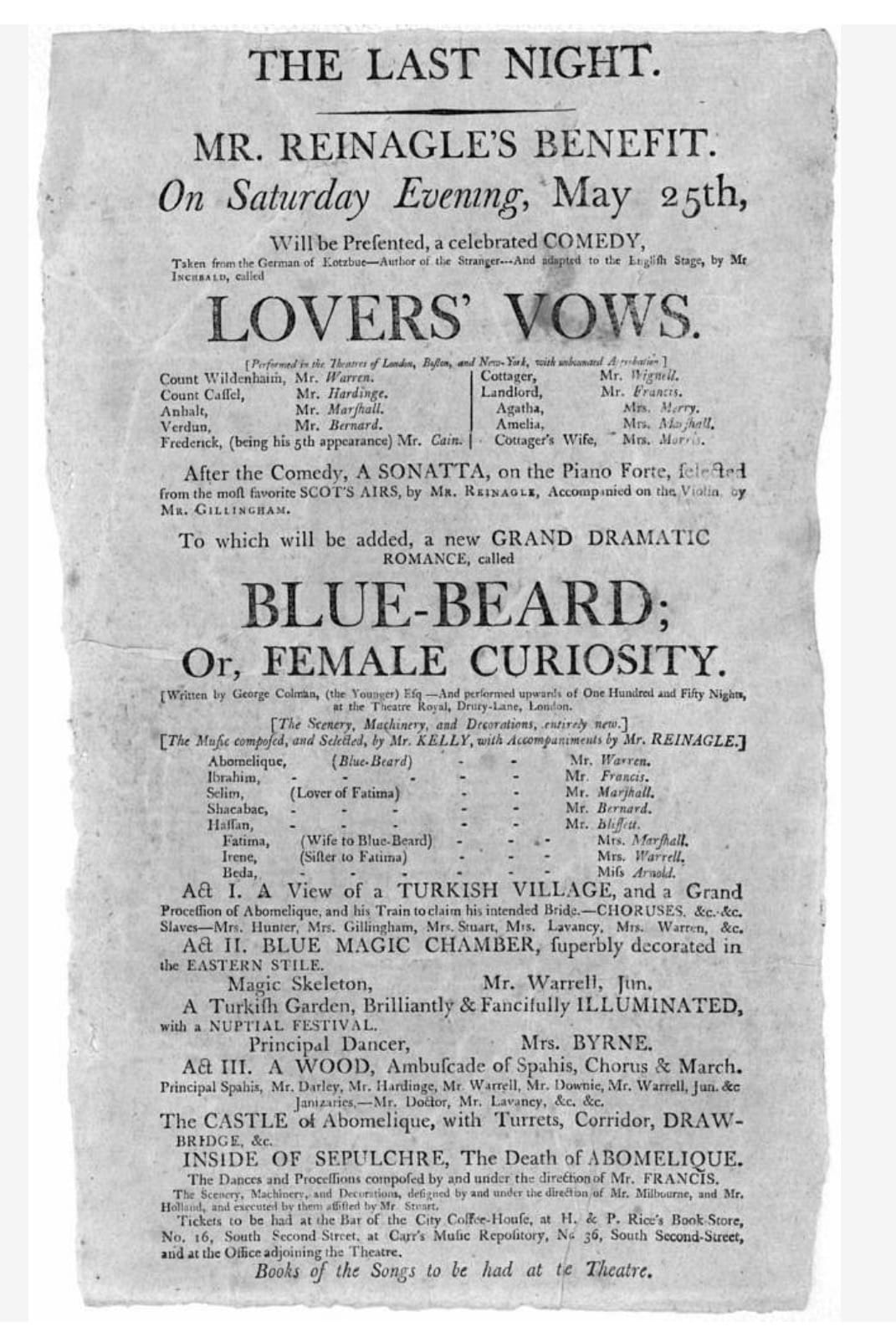
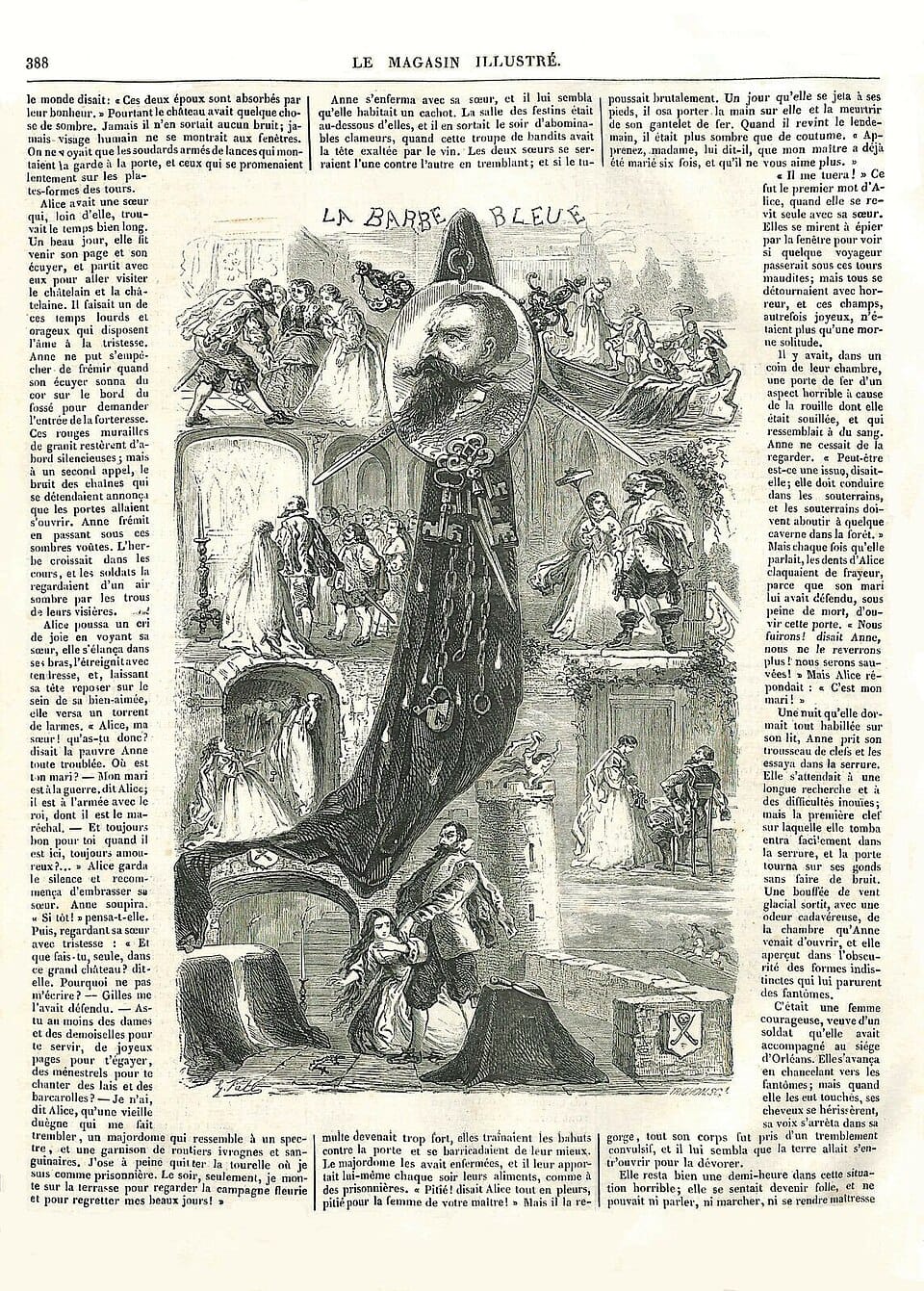
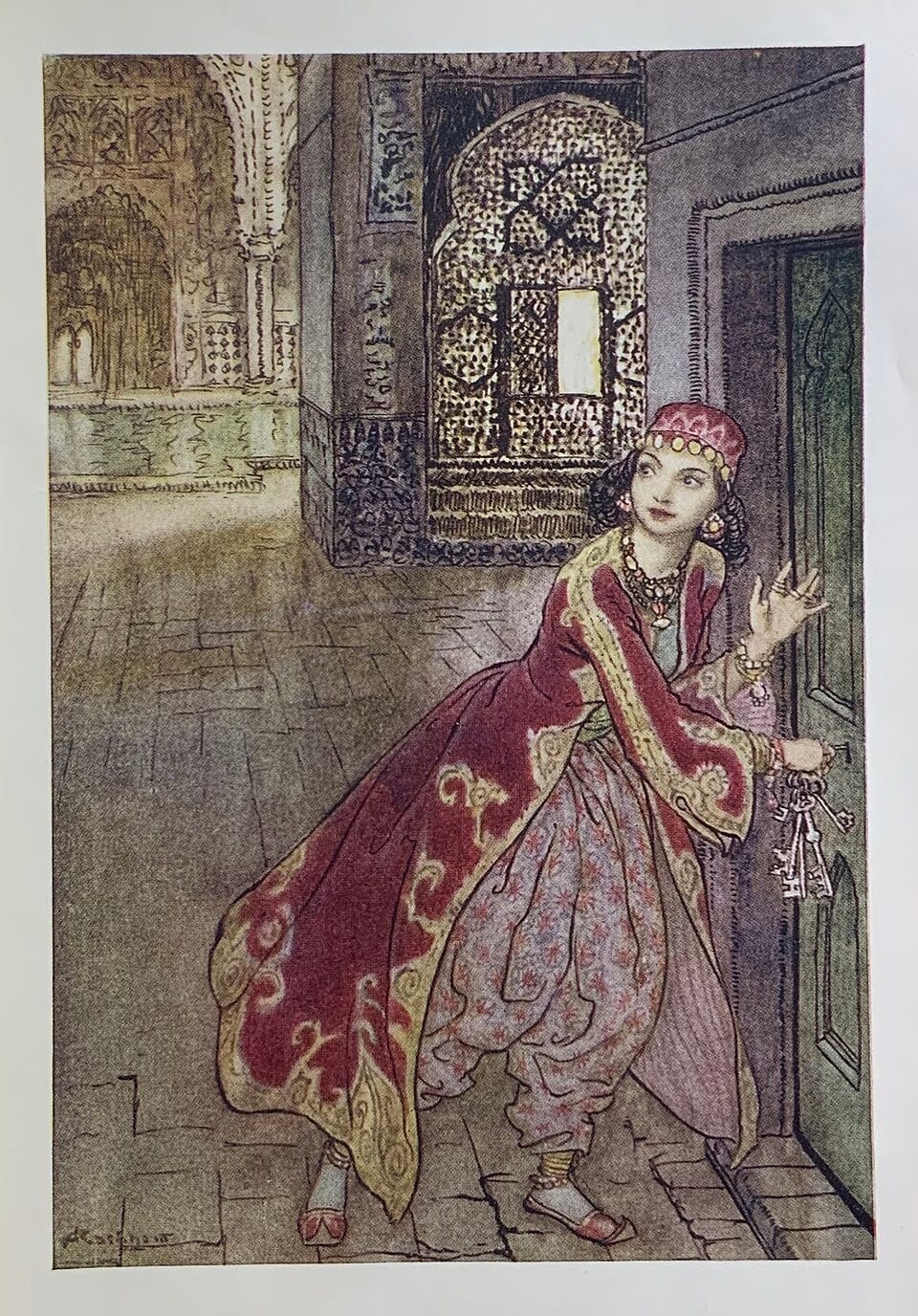
The story of Bluebeard is one of the creepiest, most haunting stories we tell to children, and it is also one of my favorite stories since childhood because it is so creepy. A young (French) woman of “good parentage” becomes enamored with a rich man named Bluebeard, who is almost always depicted with a turban and scimitar accompanying his long, silky, dark beard. The French wife moves to her husband’s palace, where there are many rooms bedecked with every pleasure she could desire. One day, Bluebeard travels afar and leaves his keys with the young bride. He instructs her to take her fill of every room except for one. This one teensy tiny room must never be opened. If she opens it, he warns, he will know, and she will suffer his wrath.
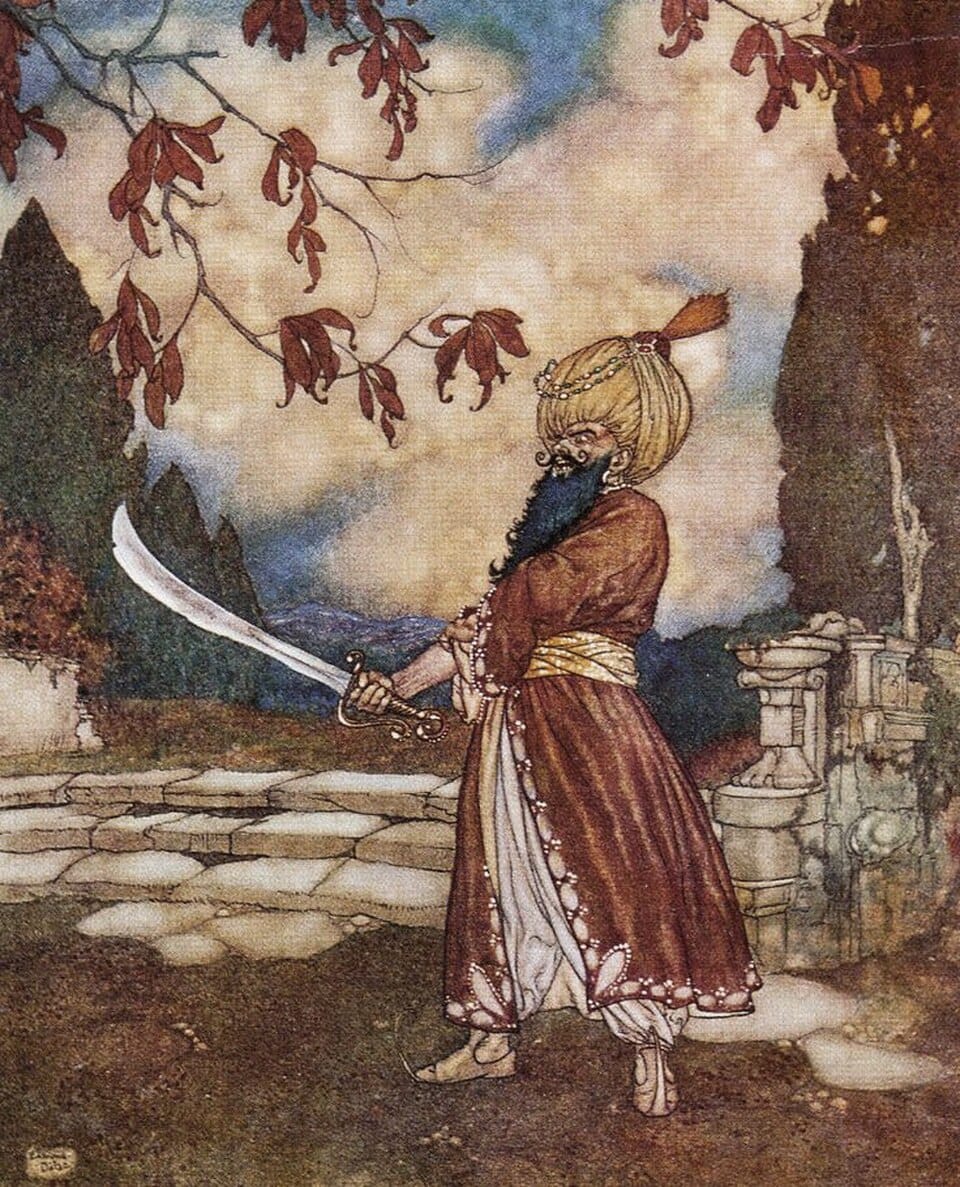
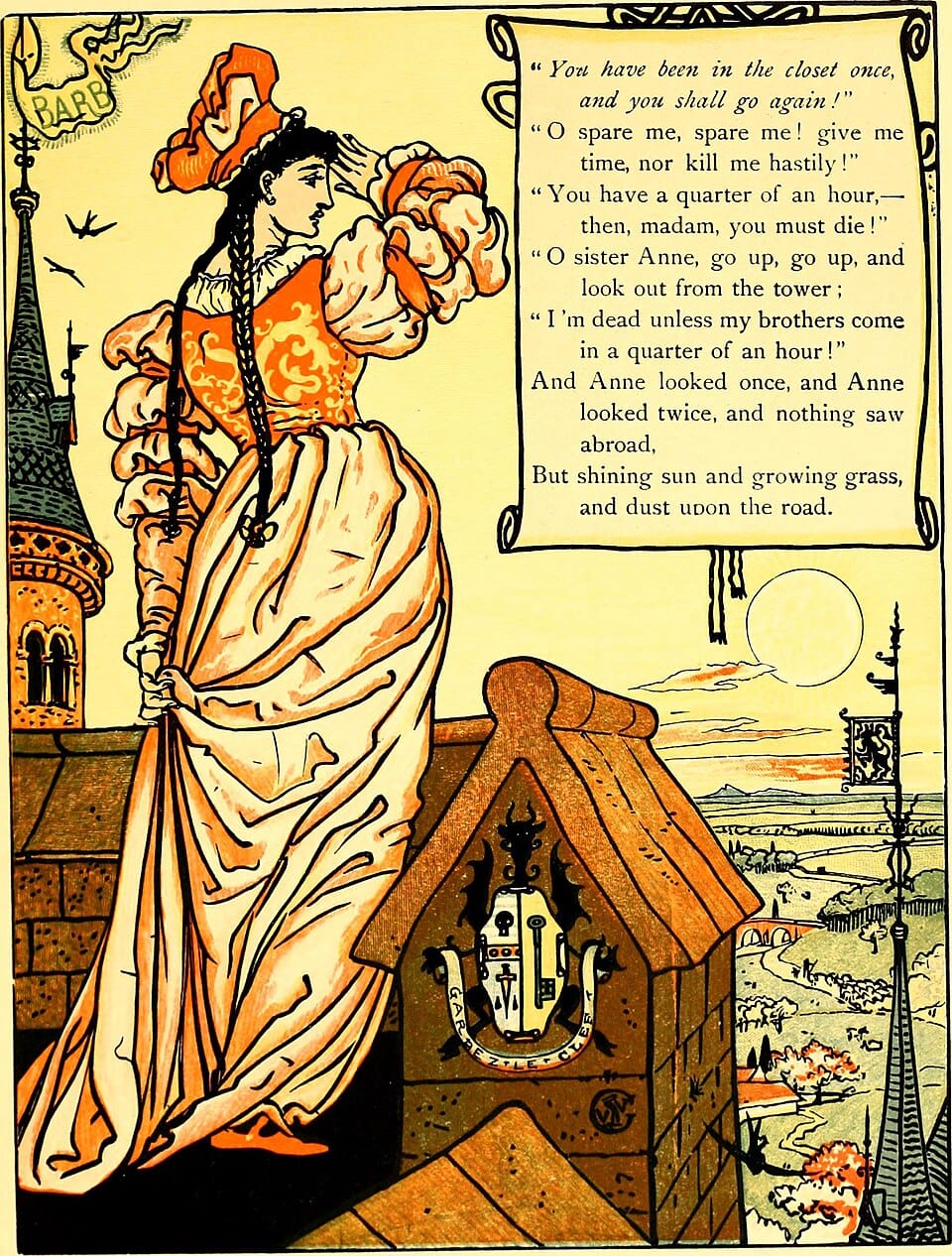
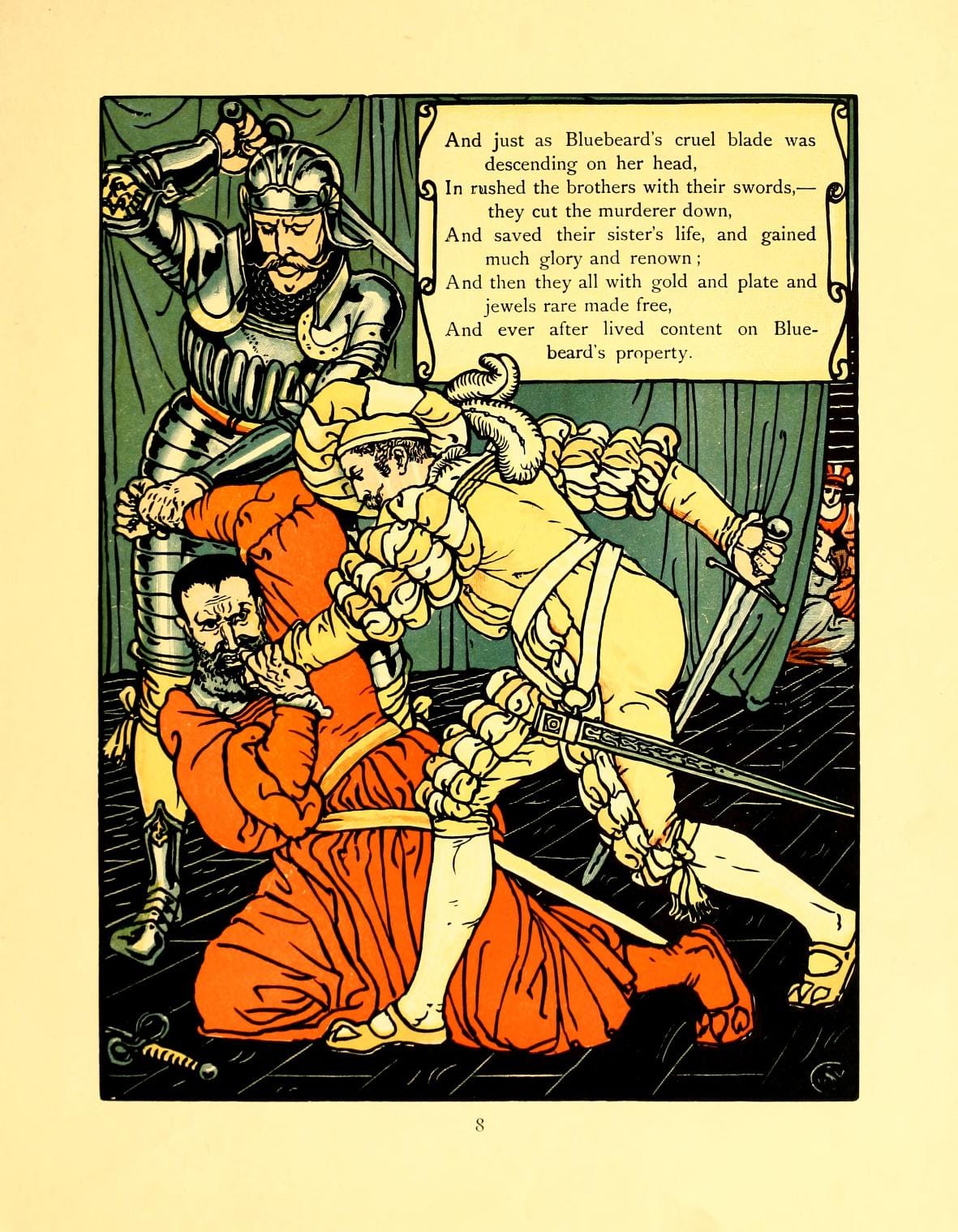
Spoiler: she opens it. It’s filled with the bloody, dead bodies of Bluebeard’s previous wives. In horror, the young wife drops the key in a pool of blood. The key gets magically stained, and there is nothing she can do to clean it. Her fate is sealed; when her husband comes over the horizon, so comes her death. The French wife's brothers learn of her troubles just in time and ride out to save her from her murderous husband, murdering him.
Many stories warning about outsiders like this depict the woman as being in danger rather than the man, and this plays out statistically in the real world. Murder is still the second leading cause of death for pregnant women, and women are usually murdered by an intimate (male) partner or family member.
Sometimes women murder their husbands for profit, and we have a name for this archetype: black widows. A woman murdering her husband for profit is a rarer event, and because of its rareness, it’s much harder to recognize when it’s happening.
In fact, in many Black Widow stories, the world doesn’t piece together the truth of what’s happening until the third or fourth husband dies under mysterious circumstances; otherwise, few suspect foul play. Second spoiler alert: if you didn’t watch the trial, the phrase “black widow” becomes a whole thing, up to and including a huffy defense motion for a mistrial.
These black widow stories are often urban legends and aren’t typically stories of a man marrying a strange woman not known to the community that raised him. When we do see those stories of men falling for strange women, they usually don’t result in the man’s death. Instead, the man disappears into Fairyland. The consequences are that he doesn’t visit his family, and his mother and sisters have no idea what is happening in his life. Estrangement is the consequence, rather than death.
In the cases in which he and his fairy wife settle down in his neighborhood, the story goes that the husband betrays the magical woman’s trust. The magic wife takes their magical kids and goes back to live with her magical kind. “The divorce came out of nowhere” kind of situation. She doesn’t kill him, but she does occasionally make him wish he were dead.
This is real life. Nothing to see here.
When the stories do end with the man’s untimely demise, our stories—and our collective distilled wisdom—become more cryptic and symbolic. There’s usually a haunted house or a ghost involved in the whole affair, and—in my belief—these are analogies for the dangers of marrying a (female) spouse with an untreated mental illness.
Jane Eyre is a good example of this but is also spoiled by that racist element. Mr. Rochester’s first wife, a wealthy West Indian woman who has enriched Mr. Rochester but doesn’t have the good sense to die, is alive. He locks her in his attic, and throughout the story, she haunts his house, a punishment for Mr. Rochester’s mortal sin of marrying a promiscuous woman not of his race. (Intense side-eye coming from yours truly.) Back in that time, mental illness was a sign of moral failing or moral inferiority.
Mr. Rochester even calls his wife “a clothed hyena.” SO THERE’S THAT. NOT RACIST AT ALL.
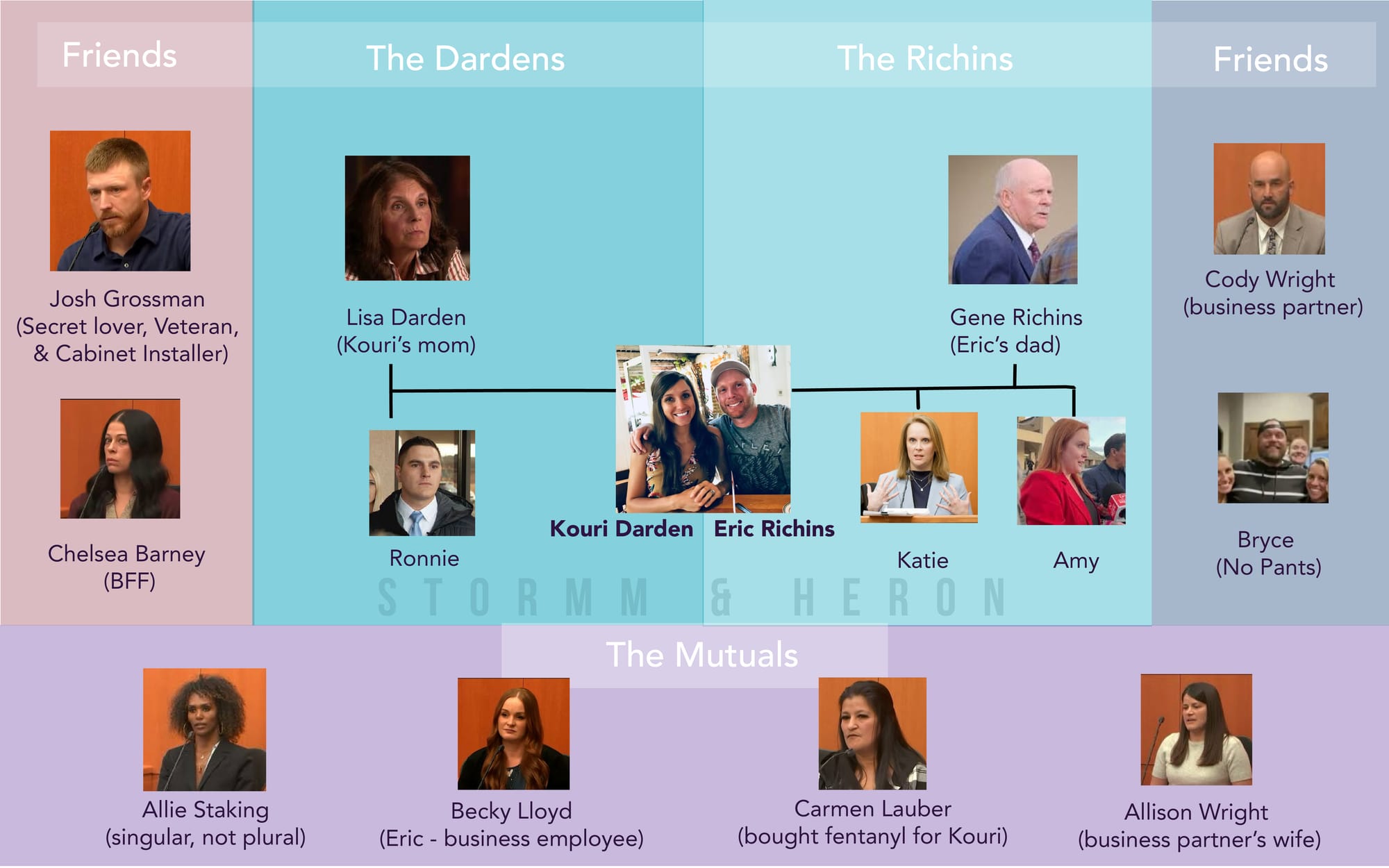
As far as I know, the only animal name Kouri got called was “a white tiger walking in the jungle” by her secret lover, veteran, and cabinet installer Josh Grossman.
Why is the lack of reliable stories important in Kouri's case? Both of Eric's sisters live with undeserved guilt over not having done more to save their brother; truly, it is our wider culture and collective wisdom that failed Katie, Amy, and Gene.
Stories are how we pass complex truths down to each other over the ages. The story details shift here and there, but the core message frequently remains the same, mostly because humans largely remain the same. Stories embed patterns in our subconscious that allow us to recognize danger or opportunity for reward. Stories arm our gut hunches and encourage us to listen to them.
We have lost access to good stories about how to evaluate outsiders for marriage. We have lost access to good stories about how to help outsiders integrate with our families without losing their own identity. And, thanks to misogyny, we've lost an ability to trust Western wisdom around recognizing when a woman is a killer.
For the stories that we do have, such as Cinderella, the cautionary elements have been removed, and the point of the story is the wedding; it gives us no insight into how to make a happily-ever-after when a partner has untreated childhood trauma.
Let me be clear, I am not arguing that Kouri was dangerous because she came from a lower socio-economic class than Eric. Not at all. We have another recent case of Brian Walshe, who murdered his wife, Ana Walshe. Brian came from an upper-middle-class household with a silver spoon planted deeply in his rear end. Ana was admirable and had to work for everything she had.
What I am saying is that class differences contribute to conflict in the form of a gap. There is a dissimilarity in the assumptions each partner makes about micro and macro situations, a different sense of what’s acceptable and what’s not acceptable.
In the worst cases, you can have one spouse take advantage of the other, sliding under the radar because the other doesn’t know the patterns to watch for or what they mean. Class can help inform what kind of story each partner tells themselves about their marriage and how they expect it to go, and if the stories are too different, alienation takes hold. Alienation is a thing that happens in marriage regardless of class or racial difference, but what we do about that alienation can also be influenced by our upbringing.
In the article “Marrying Across Class Lines,” Jessi Streib asserts that couples feel that their class backgrounds are in the past, but that class shows up in every aspect of their lives together. In a string of interviews with couples who married across class lines, Streib found that class origins shaped how each partner wanted to use resources, how they tackled tasks, and how to spend their time.
Let's set aside all of the fraud that Kouri is alleged to have committed (there is still a second criminal trial pending that will focus on financial crimes) and focus on the most rudimentary aspects of Kouri's and Eric's conflict. They disagreed on how to use resources.
That is hard enough as it is, but the real trouble ensued when Kouri made decisions on what exactly she was going to do about those disagreements. Kouri was not singing from the same hymnbook as Eric. They weren't even in the same church.
When we’re children, we get day-by-day instruction from our parents about how we should respond to situations, and these instructions are shaped by the resources historically available to the family. They also are how we learn about how the world works; they’re how we learn cause and effect, what invisible trigonometry is required to get from point A to point B in life, and how to effect change.
Kouri’s understanding of the world was not only shaped by her family’s economic hardships; her understanding of how things work, specifically, was shaped by her parent’s absence. When you’ve survived childhood neglect, you don't knowthat you don’t know how the world works. Not the world you actually want to be in. You only have the instructions on how to make a near-exact replica of the world you came from.
There's no reason to be ashamed of this at all, but we have extensive supplies of shame. We have trust funds of shame. We receive monthly shame dividends. We have a special trainer who lives in our heads, one part life coach, one part torturer. Their job is to inform us of every aspect of our day that indicates a deeper state of shame. We have far more shame than someone who had the benefit of a stable upbringing. Some people are "new shame"; we're "old shame."
There's the ignorance that comes with a neglect wound, and then there's the added bonus of having shame around that ignorance.
What I’ve seen and experienced around this phenomenon is that there is an immaturity to our understanding of the world and ourselves. We never had consistent access to that “invisible trigonometry,” and by "invisible trigonometry," I mean the values, acceptable credentials, and best practices that create the situations we desire. We don't have access to the roads that will take us there. Without that, what we have left is magic.
It's like a child whose parent leaves for work and the child also doesn't see the means of transportation. Some children assume that their parent walks out the door and disappears, reappearing at their "work," whatever that means.
This ignorance is critical in understanding any and all of Kouri's actions (even up to the statements she made at her sentencing today.) For all human beings, regardless of background, magic will fill the space where method is missing. Understand this, and you can suddenly spot the threads of conflict that emerged between her and Eric and what she has been after her whole life.
Kouri murdered Eric. Kouri murdered Eric for his money. But I don’t believe that is what the money means. Let’s highlight what Kouri did have.
When you have been chronically neglected, access to the world is limited to what you can see and what scripts you hear repeated throughout the day. It’s like childhood dress-up and play-acting: if you want to be a doctor, find something that looks like a stethoscope, and voilà, you are the doctor! With a neglect wound, your understanding of how to be an actual doctor advances as you get older, but not by much. Something something school. Something something grades. Doctors are smart. That's it!
If you can convince people that you are really smart, then you should be treated like a doctor because you are as good as one. In adolescents and adults, the act of convincing is analogous to the toy stethoscope that transforms you into a doctor.
After all, other doctors get people to believe they are smart. Why else do people listen to them and pay them the big bucks? This sounds like I'm being trite, but I'm not. "If I am smart, and doctors are smart, then I am also a doctor" is the logic pathway that Kouri takes when committing fraud. Or lying to anything and everything that has a face.
Let's talk about the real world. Let's talk about an unspoken first step needed for a person to actually become a doctor: you need an identity based on self-knowledge and core values.
For a person with an untreated neglect wound, understanding of themselves is as limited as their understanding about how people achieve good things in the world. Your parents are critical in helping you develop your sense of self. Failing this, you are shit out of luck if a capable, stable adult doesn’t step up to the task of guiding you to understand yourself. You never learn how to know yourself because your parents never showed you in word or in deed that you are worth knowing. In fact, they taught you the opposite.
If you're reading this, and you see shadows of yourself in these descriptions, I want you to hold yourself close. You are a worthy person. You are valuable. You are about to embark on a grand adventure of self-discovery. Kouri's actions are not your fate. Shame is not your beginning, your middle, or your end.
A common symptom of abandonment and neglect in adults is that you are a different person to your friends and family members. Your personality shifts slightly when a new player takes the stage.
There’s a simple rule that plays out here: for a person living with an untreated neglect wound, the world functions from the outside in. Things have to happen outside of you for your insides to change. To be happy and healed, you must win so-and-so’s heart, finally be recognized for your specialness, win the lottery, or get a lot of friends. Not only this, but your identity is also wired to function from the outside in. You are whatever your surroundings are.
When you have no internally sourced identity, you can't have core values; that means that outside circumstances decide what actions you take and make you a reactive person.
When core values are present, your values determine your actions.
We see this "outside-in" thinking in Kouri’s efforts to be happy by pursuing a stable family.
Her former co-worker describes Kouri's and Eric’s initial romance as them being inseparable from day one. I suspect this is because Kouri absorbed Eric’s identity as a means of buying into the dream.
What are the poisonous roots that blossomed in those nine years between marriage and murder? Shame, the mask, and the growing gulf—not a lessening gulf—between Kouri's and Eric's worlds. Within that gulf was darkness, and darkness is the reason Kouri was able to plan Eric's murder, fail at her first attempt, and succeed a second time without being stopped.
A person moving in darkness is also someone who can’t be helped. Who can’t be healed.
When Kouri met Eric, she parroted the words he said, thus taking up the mask and magically turning into his princess.
Incidentally, until the day he died, Kouri was listed in Eric’s phone as “my princess.”
My eyes sting with tears writing that sentence. I can’t imagine how Eric's family feels, and I don't want to ever know how they feel, but my heart goes out to them with every word.
Next up: Dark Cinderella - The Deadly Undertow
Thank you for reading
If you’re enjoying this series, please consider sharing and supporting my work by buying me a cup of coffee! I appreciate it, and it goes a long way to helping me do more of what I love most.
Referenced notes and sources:
- The most dangerous person in a woman’s life remains her husband. Here is a depressing set of statistics that demonstrate how bad it really is.
- I’m so thankful for this article by Jessi Streib for helping me communicate the ways class plays in this case. If you’re not already familiar with the work of Pierre Bourdieu, there’s a digestible reference to his work in the article!
- The art in this article is a parade of Bluebeard artwork demonstrating the moral misdirection our collective stories have engaged in. The moral of the stories are not that people need to be examined closely for their character, but that racial and ethnic outsiders, or having too much curiosity as a female will result in your violent end. This is why we have lost trust for these stories as modern readers.
- Extensive details about the case have come to light around the sentencing of Kouri Richins. I will include these details in future installments. However, no further insights were given as to the location of Bryce’s pants.
Humor aside, please join me in respecting the privacy and feelings of the Richins family and in honoring Eric’s memory. The Darden family is also hurting. Kouri has done incredible destruction to several families. This writing is not meant to glorify the killer and erase the victim. At the center of this is a father who gave everything to protect his children.