Kouri Richins: The Deadly Undertow (Dark Cinderella Pt. 4)

In all stories, there is a passage of time for events to go another way. In happy stories, there is a period in which things could turn out sad. In tragedies, there is still hope of redemption for much of the story: hope that Hamlet might become king of Denmark or that Juliet wakes just before Romeo takes his life. Anyone who has ever lost anybody to sickness, divorce, or betrayal has spent hours, days, or lifetimes combing over the tiny moments just before the seemingly inevitable happened.
It’s not madness; there is a purpose to some reflection. We think about these moments just before the cataclysm because we wish we could go back in time, yes, but we also think about them to evaluate the present and change the future.
Dear Reader, in this installment and the next, we are in that space of Eric’s and Kouri’s story in which things could very much still go another way, in which flags appear and disappear so quickly we can’t quite tell whether they are red, yellow, or green. The events of these installments are the most important ones for our purpose of preventing something like this murder from happening again.
I don’t have the answers. I have insights, I have ideas, and I have observations. These writings are not about me having answers but about the collective power of pattern recognition. It’s about us finding answers together to make our world safer for all of us and to honor the humanity of those who have suffered.
So I’m asking now that you pay close attention here because the observations and connections recorded in this installment may seem vague at first. I even questioned whether I should include them. But after the unexpected revelations in the sentencing memo issued by the prosecution only two days ago, what I am describing here predicts those revelations we’ve had about Kouri’s relationships with her children. Things that are predictive can also hold the power of prevention. What is here predicts the allegations of abuse and alienation and even the moments Kouri used her children to construct her alibi as she murdered their father.
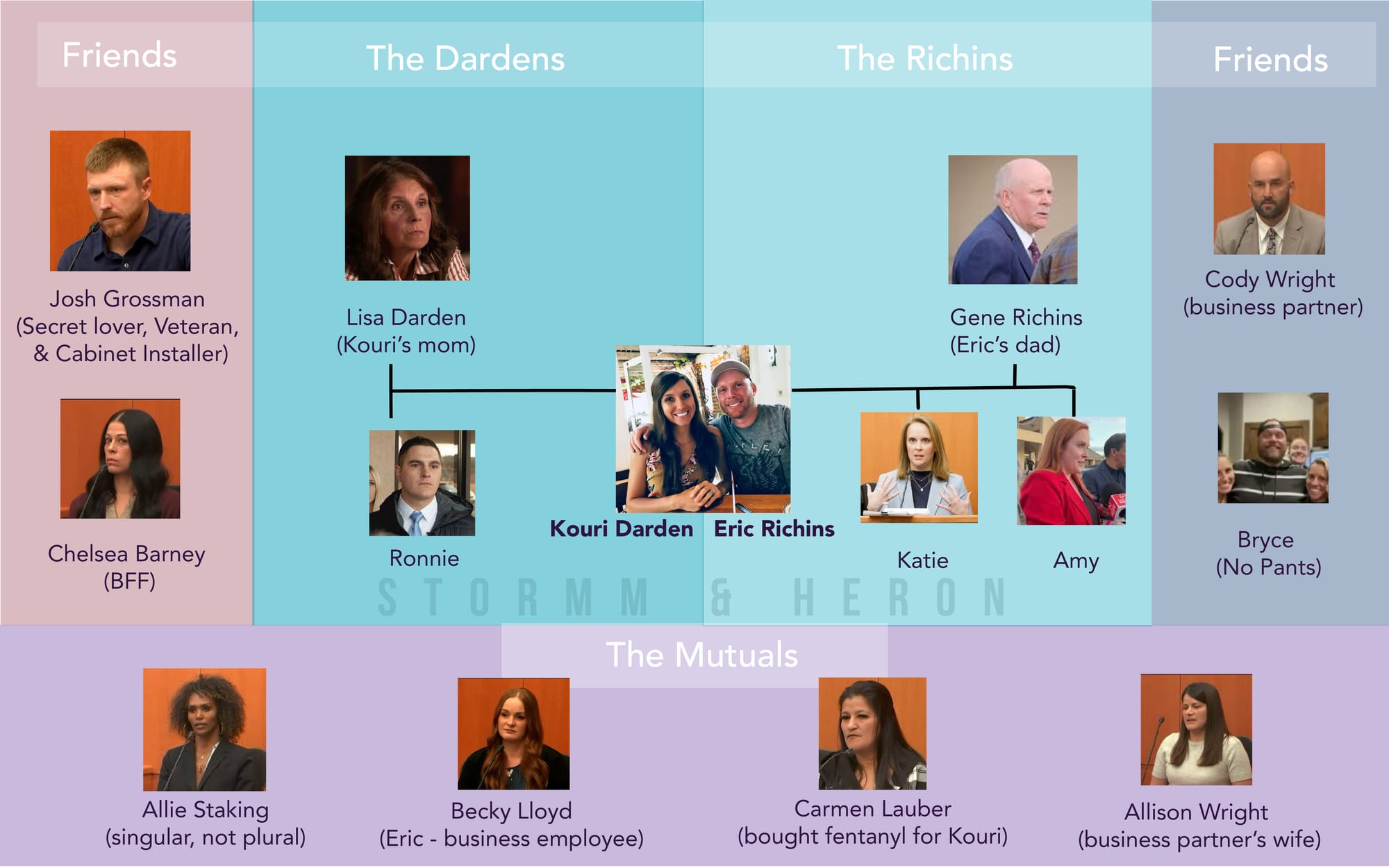
Let’s get into it.
Referring back to the article by Jessi Streib, different socio-economic classes have differing ways of parenting. Working-class families frequently have to parent with restricted resources, which includes time and emotional bandwidth. This creates a more hands-off approach to rearing children with a practice of letting kids figure things out for themselves. There are advantages and strengths to this approach, but we should not romanticize what is happening; it is primarily a way of deciding how to handle limited resources: you pick your battles.
Middle- and upper-class families are far more involved with the intricacies of their children’s lives. There’s an expectation not only to show up for their children’s special events but also to be on the planning committee for those events. On its face, there is an expectation of higher emotional availability and physical presence from parent to child. It’s an actual option for these parents.
Eric’s parenting style is reflected in the above paragraph.
During the trial, witnesses repeatedly described Eric not as a good dad or even a great dad but as an incredible father, highly engaged, and a best friend to his children. Eric coached his boys, but he also coached and encouraged their teams and made a difference in those children’s lives.

He raised his boys to be competitive, but he also was incredibly tender with them. Katie Richins, Eric’s sister and estate executor, shared a vivid and beautiful memory that illustrated this tenderness. I’m so glad she did.
One of Eric’s sons loved horses, just like her, and so Eric would bring that son over to the family ranch to spend time with his sister Katie, to whom Eric was closest. Katie would ride for hours with her nephew on her lap. Eric would follow along beside them on a four-wheeler loaded with snacks and water in case his child got hungry. When his son became drowsy, rather than cut the trip short and take him away from his beloved horses, Katie would pass her nephew down to her brother. Eric would hold his son in his arms as he slept, and when the little boy awoke, Eric would pass his child back to his sister so that the baby could return to the saddle for more joy.
That story is an example of the emotional engagement that the Richins family prioritizes. I love my parents, but I can’t see either of them spending so much energy on my joy; they love me, but that’s not how they were treated. They learned to handle the family’s emotional resources differently. It could even be interpreted as spoiling or coddling a child, perceived as a form of mistreatment, of all things.
In contrast, we can glimpse what Kouri grew up with in the body cam footage of the night she killed Eric.
Kouri calls 911 at about a quarter after three in the morning. She tells them she had been sleeping with her son and returned to her and Eric’s bedroom to find Eric cold and stiff. Kouri is reluctant to begin CPR. The police are on scene within ten minutes. Red and blue lights flash outside the house and into the cold March night. Those three boys, the eldest of whom was nine and the youngest was three, would have seen those lights; heard the clicks, beeps, and shots of static from the police radio; and heard the progression of heavily booted feet moving quickly to the place where their father had slept. They probably noticed that their father’s voice was absent from the commotion.
Quick question: if you were their parent, what would you do?
In the first few minutes that the emergency responders arrive, Kouri calls for her mother to come to her house because something has happened to Eric. Before Lisa Darden arrives, we have already heard the roar of a Lucas machine attempting to resuscitate Eric, and we have already seen the finality of Eric’s lifeless body covered with a single white sheet while officers examine the prescription bottles littering his side of the bed. This is the scene Lisa walked into. Anyone would be able to see it was a life-and-death situation.

Kouri sits on the sofa with her head bowed, making sniffling sounds, her hands covering her face. Her mother, Lisa, seats herself a foot and a half away on the same sofa, watching the police officer in front of her, even if he is not talking. Lisa’s hands are in her lap, tucked between her thighs. At no point do we see Lisa reach out and hug Kouri. In fact, at one point, Lisa even suggests that Eric’s three boys need to go back to bed. I don’t think the suggestion to put the kids to sleep was out of coldness, but it sure looked like it. This camera footage is the only time we see Kouri with her mother, so there’s a modest chance that Lisa’s distance is not normal and instead a sign that she, too, felt the hollowness, the off-ness, of her daughter’s crying.
Watching the footage for the first time as it played in court, I clocked the cool distance of a childhood in a house without hugs. I am a mother, and I was confused about why Lisa and Kouri weren’t gathering those three babies to them if Kouri were innocent and this was all truly a surprise to them. A parent’s desire is for their children. We want to comfort our kids, but we are also comforted by them, by knowing that there are a million horrible things in the world we cannot control, a million ways in which it is unclear about what is right and what is wrong, but holding your children and comforting them, soothing them? It’s never wrong.
This scene of space between Lisa and Kouri left me with the impression that this wasn’t the first time Kouri experienced something ostensibly distressing only to be “soothed” by a mother who did not touch her, did not tell her everything was going to be okay, and did not validate her distress.
I have no doubt that Lisa Darden loves her daughter. I think Lisa does. But Lisa's cool presence is a world away from Eric’s overt tenderness toward his children.
One additional note in that vein: if Lisa Darden is Midwestern in origin as Kouri’s Oklahoma birthplace suggests, her displays of affection are influenced by that as well.
In the journalistic entry Kouri created at the retreat in Sedona in which she describes her childhood, Kouri indicates a change in her relationship with her mother. She states that her mother is now one of her best friends, and that gives us further insight into Kouri’s lived reality as a child: it was more distant than what we saw on the body cam. The body cam footage portrays an improvement in how Lisa treats Kouri.

Getting back to the mask and getting to the time before it was all too late. For those years between 2009 and 2022, Kouri acted out the fantasy of a happy, stable family; she was also mystified as to why the smile on her mask never reached her heart. She would have been incredibly lonely at this time, but there wouldn’t have been much Eric or anyone else could do about it. The masks we wear—so long as we continue to wear them—keep people from being able to touch, to warm, and to heal the areas we ache most deeply. We must remove the masks, risk rejection, and show our real selves.
Here’s the catch and the tragedy: there is no real Kouri. What we know of Kouri is an assemblage of coping mechanisms designed to avoid facing her shame. She has a real heart and a real brain, but not a real identity. True identity (I'm using that term flexibly) springs from the inside and flows out into the world. We know someone has become individuated when they define their identity through their choices rather than through what has happened to them in life, how they were wounded, or how they were favored. Kouri's flow is all outside in. Her identity is a reaction to the circumstances of her life.
This wiring would impact her children, her marriage, and the way she has and continues to pit herself against the world.
As the boys grew, Kouri’s unhappiness would only increase. She may have even felt sometimes that she was an alien in her own home. As Kouri watched the brightly colored carousel of her children’s happy lives, she must have wondered why her own heart couldn’t be touched by that happiness.
Her children were being raised in a socio-economic class that Eric was native to, but Kouri was not. Kouri had entered Eric's class, but only because of his income and not her own. Even when Kouri did have an independent income, it didn't make her feel like she belonged because shame would do the heavy lifting of alienating her but also drive her to prove that she did with Sisyphian fervor. Her children’s lives had tastes of emotional security and nurturing in hues and tones deeper than Kouri had likely ever seen in her life. As Kouri sits in her jail cell waiting for sentencing, she has probably never tasted it for herself, even now.

She and her children live in two different worlds. They have lived in two different worlds for a long time.
This made her angry on some level and made her defensive and resentful, maybe not initially, but eventually. As that anger and defensiveness grew, she and Eric would start having regular conflicts over what looked like nothing but meanteverything.
Kouri would have fought for power and control over their relationship. Eric would have, too. This power struggle is a normal cycle in every intimate relationship out there, even if it’s not something that immediately comes to mind when we reflect on relationships. We talk about the romance of marriage, the tedium of marriage, and the comfort of marriage, but we don’t often talk about one of the most common aspects of marriage: the competition.
Eric and Kouri had deep disagreements about the direction they should go as a family and how they each individually fit in that family. Eric was industrious with a great work ethic; his masonry business netted them a half-million a year. Eric wasn’t thinking about what he needed to prove to the world about himself; he was focused on deciding what kind of experiences he wanted to have in the world. He was ambitious with growing his business because it felt great to grow it, it afforded his extended family opportunities, and he loved hunting. Eric was emotionally available to his world. His kids were top of mind; he wanted Kouri to stay home and care for them. Kouri did not want to stay home, and I think she was right to resist it. To force a parent to be the primary caretaker for their children is to raise those children with a parent who is always there, but the kids will feel like they are unwanted, broken, and insufficient to make that parent happy.
As I’ve covered, Kouri does not have the luxury of an identity that isn’t defined by her woundedness. Her sense of self is extremely fragile; her sense of self is always backed into a corner. The thought of staying home and looking entirely after her children probably summoned primal panic and the sense that she was dissolving and disappearing.
For Eric’s part, Kouri's resistance would be confusing and selfish. He had built a marriage with Kouri based on how she presented herself when they first got together and around things he thought they had in common. Kouri’s mask was convincing, parroting Eric’s ideas of what kind of life they were after. Kouri’s drift from that mask would strike him as selfish, and some of it probably was. Which Kouri should he believe is the real one? The one he fell in love with, or the one that was so persistently unhappy in a house full of the richness of family?

Eric knew that he had agency in the situation. He thought that Kouri was likely both, but he also knew that we are all light and shadow; he could influence her, and he could try to bring out the best in her for the sake of their children. He would give it time. He would speak to her better nature; surely she loved their kids as much as he did. Surely it was inarguable that having an at-home parent was ultimately better for their three boys. Why would Kouri want her boys to know the pain of an absent parent?
Kouri didn’t have an at-home parent, and her conflict with Eric became the battle of the haves and the have-nots, the worthy and the unworthy. To insist that staying home was the only acceptable way to raise happy kids suggests Kouri's childhood rendered her inferior to Eric and her sons. It was not true, but it was no less crushing. It had to sting; whatever Kouri felt about having her own career goals, she would also lash out at Eric because it was not what the fight was about; it was about what it meant. To cave to Eric and do things that Kouri perceived as “his” way (and Eric would have perceived as “our” way) would grant him power over everything. She would have to accept that her worst fears about herself were true: her childhood was her destiny, she was an inferior human being forever cloaked in shame, and she would forever be a toilet scrubber inferior to those snobs in Park City.
Eric and Kouri were having two different wars. Eric was fighting for his kids, but Kouri likely felt she was fighting for her life.
But this quiet phase was ending.
Kouri needed another mask; this wife-and-mother one wasn’t making her happy. She obtained her master's degree, likely in 2017, and then, in 2018, the fragile foundation of her life broke.
Eric was having an emotional affair.
Next up: Dark Cinderella - The Shattered Slipper
Thank you for reading
If you’re enjoying this series, please consider sharing and supporting my work by buying me a cup of coffee! I appreciate it, and it goes a long way to helping me do more of what I love most.
Referenced notes and sources:
- Here’s a link again to this article by Jessi Streib on marrying across class.
- Watch the body cam footage from the trial here.
- There are some incredible body language analysis videos of the body cam footage out there. These are professionals in body language analysis but also in psychology (I am not.) Be sure to check them out. Here are some of my favorite: Sadie - The Prime Minister of Behavior has one here and I Don’t Belong Here with Samantha Benigno MS, MA has a video in which she exclusively analyzes the footage (I love this channel).
- MISSING : BRYCE’S PANTS. REWARD OFFERED.
- …The reward is my gratitude.
Humor aside, please join me in respecting the privacy and feelings of the Richins family and in honoring Eric’s memory. The Darden family is also hurting. Kouri has done incredible destruction to several families. This writing is not meant to glorify the killer and erase the victim. At the center of this is a father who gave everything to protect his children.